
It’s time to apply for a new job. You’ve recently graduated and are looking for your first job. You’re ready for a step up in your career and are prepping your CV and cover letter to reflect your experience. You’ve been made redundant and are using the opportunity to find a career that you really want. There are numerous reasons why you might need to give your CV and cover letter a makeover.
Your CV and cover letter will be the first things that prospective employers will see about you. Follow this short 3-part guide on how to write a CV and cover letter to make sure it’s not the last.
1. How to structure your CV
Ensuring you have a clear and accessible CV will be crucial to increasing your chances of being shortlisted as a suitable candidate. Here are our key pointers when it comes to structuring your CV.
Formatting
Use a clear font and a simple colour scheme (black and white is fine) to increase the readability of your content. Your audience, i.e., a hiring manager, will initially want to scan your information to establish that you meet their requirements. Therefore, ensure you use clear headings and sections throughout your document. Also, use bullet points to outline key details and examples.
Length
Unless you are applying for an academic role, recruiters will typically anticipate a 2-page CV for your application. Anything beyond this is unlikely to be reviewed.
Order of content
Whilst the order of your content might vary depending on the stage of your career – for instance, if you are a recent graduate, your degree overview might appear above your work history – the following sections should be included in the suggested order below:
Contact information
Include your name as the main heading of your document, followed by key contact information, such as your email address and mobile number. Avoid including unnecessary details, such as your full address and date of birth, as these are not needed at this stage of the recruitment process.
Professional profile/summary
This section should be 2 – 3 key sentences that offer an introduction to you as a candidate and should be tailored for each application.
Address who you are, what relevant experience, knowledge or skills you have for the position you are applying for. Indicate what your objective is with this version of your CV. This introduction should hook the reader and encourage them to read on.
Career summary
Ensure you present your content in reverse chronological order, starting with your most recent experience first. The first role you list is likely to include more detail than your previous roles, showcasing your current capabilities.
When presenting your work history, consistently use bullet points to describe what you did and what you achieved in your role.
Education and qualifications
This section is likely to be brief for established professionals, simply listing the qualification, awarding institution, and the date completed; whereas for recent graduates, you might want to include more detailed information about the knowledge and skills you have developed through your degree programme.
Interests
You can look to outline key interests and activities you are involved in outside of work, but only incorporate this section if your hobbies also showcase transferable skills and/or attributes to the recruiter.
References
There is no need to include the contact information of references as part of your CV. Instead, simply state at the bottom of your second page References available on request.
2. What to include in your CV
Knowing how to write a good CV is tricky, but in short, your CV needs to show that your career background and experience match the job you’re applying for.
Here are some key points to consider when deciding what to include in your CV:
What questions does your CV need to answer?
Your CV is one of the first things that recruiters will see about you, so it’s worth trying to look at your CV from their perspective. Does it catch their attention, and does it give them the information they need?
- Include your personal details – name, address, phone number and email. Do not include your age or a photograph unless specifically asked to do so.
- Employment history – put your most recent achievements first
- Keep your CV short, while still including sufficient detail. It sounds tricky, but it can be done. Academic CVs are usually at least 4-5 pages long, whereas CVs tailored to the private sector should be only 2.
- You can sound professional without using excessive jargon. Keep your writing clear, direct and focused. Remember that the person looking at your CV might not be an expert in your field.
- Use ‘doing’ words on your CV, such as ‘developed’ or ‘organised’. This makes you sound active and not passive. But avoid clichés. You don’t want to be just another “fast learner” with a “good work ethic”.
- Don’t talk about your social life unless your activities display an important skill such as leadership or teamwork.
- Most importantly, proofread your CV. There should be no spelling, punctuation or grammar errors: unprofessional CVs are rejected. If you find editing your own work difficult, get a friend to read your CV.
- Once complete, show it to as many people as possible – your supervisor/mentor, colleagues, even your family and friends. Their first impressions will help you to improve your CV.
Will it get through the applicant tracking system (ATS)?
Did you know that many employers are now using Applicant Tracking Systems (ATS) to assist in the shortlisting of applicants? This is basically software that scans your CV and cover letter for matching keywords to ensure that you are a potential match for the job before sending the application through to HR for review. In short, its purpose is to eliminate the least qualified, not identify the most suitable. So you’ll need to make sure your CV meets the job requirements so that it can get through the ATS and be reviewed by an actual human. Here are 5 things you need to know about how to make ATS work for you.
Have you made any common CV mistakes?
Writing a new CV can be daunting, but going through it with an open and critical mind can be key to writing an effective CV. Look at your CV through new eyes. Try to decide if this CV came across your desk, would you hire you? Part of the process of critically analysing your CV is to check whether you’ve made any of these common CV mistakes, and fix them.
3. Your Cover Letter
If the application process involves submitting both your CV and an accompanying cover letter, then it is important to consider the purpose of each document and how they need to complement one another.
Think of your CV as a summary of your career history. It will offer “breadth” of information to highlight your suitability for the role. Your cover letter is your opportunity to really cement yourself in the mind of the hiring manager. It shows that you are both interested in the position and committed to working with their organisation. Your cover letter will reinforce your suitability for the position. It will also outline your key reasons for applying and your motivation to work with the company, offering “depth”.
Overall, when aiming to write a good CV, a clear structure to your content using sub-headings and clear sections is essential. Professional language that highlights your impact and achievements is also important. In addition, careful consideration of your audience and the purpose of your document will be key.
Start applying for jobs
After all that work, it’s now time to start applying for jobs. Remember that each job will have its own criteria. To make it through the ATS, you’ll need to customise your CV to match the job description. This shouldn’t be too hard, as you now have a solid base to start from.
When you’re ready, visit jobs.ac.uk to start applying. You can also find more guidance, CV templates and interview tips in our Career Advice.
For more CV tips and advice, see:
- Classic CV Guidelines
- How To Write A Flawless Cover Letter
- CV Advice Webinar
- Preparing to Change Jobs? Make sure your CV is ready too!

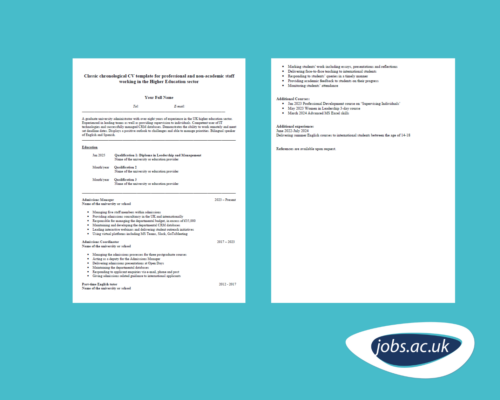


Thank for the information that you provided, it was informative.
I found this really helpful thank you.
This is really helpful. Thanks
Thank you very much.
This is very helpful keep it up dudes
This is very helpful for writing a best professional CV. It help me a lot in writing my CV. Really thankful for this useful information regarding CV writing. Keep it UP.
THIS IS VERY HELPFUL THANK YOU
Thanks, it’s quite insightful.
Will try to maintain the link for further guidance
I found this very important and very directive to me
So helpful and thanks so much
waooo i really enjoy this so much
Very good guidance
its really helping
Thanks for enlighting us
thanks for helping
it is very helpful
This was very helpful in writing my CV