jobs.ac.uk - Great jobs for bright people
  • Find a Job
  • Find PhDs
  • Career Advice
  • Jobs by Email
  • Advertise a Job
  • Recruiters
  • Your Account

  • Skip to primary navigation
  • Skip to main content
  • Skip to primary sidebar
  • Skip to secondary sidebar
  • Skip to footer

career-advice.jobs.ac.uk

Secondary Sidebar

jobs.ac.uk Career Advice

  • CV and Cover Letter Advice
    • CV Tips
    • Free CV Templates
    • Cover Letters with Examples
    • Personal Profiles
    • CV Resources
  • Jobseeking and Interview Tips
    • Jobseeking Tips
    • Academic Interviews
    • Professional Interviews
    • Jobseeking and Interview Resources
    • Interview Question Tool
  • Career Development
    • Academic Careers
    • Research Careers
    • Career Progression Stories
    • Professional Careers
    • Working in Industry
    • Career Development Resources
    • Global Careers
    • Working From Home
    • PhD Supervisor Guides
  • Women in Higher Education
  • FE Career Advice
    • FE CV & Interview Tips
    • Working in FE
    • Managing your Career in FE
    • FE Jobs Profiles
  • Resources
    • Academic Case Studies
    • Professional Case Studies
    • Job Profiles
      • Biological Science Jobs
      • Health and Medical Jobs
      • Engineering and Technology Jobs
      • Computer Science Jobs
      • Physical and Environmental Science Jobs
      • Professional Service Jobs
        • Business Development Manager Jobs Profile
        • Chef Jobs Profile
        • Civil Service Jobs Profile
        • Compliance Officer
        • Email Marketing Jobs Profile
        • Event Jobs
        • Office Admin Jobs
        • Programming Manager Jobs
        • SEO Jobs Profile
    • Vlogs
  • Webinars
  • Country Profiles
    • Africa
      • Egypt
      • Ghana
      • Kenya
      • Nigeria
      • South Africa
    • Americas
      • Canada
      • United States of America
    • Asia
      • Bahrain
      • Brunei
      • China
      • Hong Kong
      • India
      • Japan
      • Kazakhstan
      • Malaysia
      • Qatar
      • Saudi Arabia
      • Dubai
      • Singapore
      • South Korea
      • Turkey
      • United Arab Emirates
      • Work in Vietnam – Country Profile
      • Work in Uzbekistan – Country Profile
    • Europe
      • Belgium
      • Denmark
      • Finland
      • France
      • Germany
      • Ireland
      • Italy
      • Netherlands
      • Norway
      • Russia
      • Spain
      • Sweden
      • Switzerland
      • United Kingdom
    • Oceania
      • Australia
      • New Zealand
  • PhD and Studentship Advice
    • PhD Guides
      • Before your PhD
      • During your PhD
      • After your PhD
    • PhD Advice
    • Studentship Resources
    • PhD Vlogs
  • Need help advertising a job?
  • About jobs.ac.uk
  • Ask A Professional
  • People in Education
  • Menu
    • CV and Cover Letter Advice
      • CV Tips
      • Free CV Templates
      • Cover Letters with Examples
      • Personal Profiles
      • CV Resources
    • Jobseeking and Interview Tips
      • Jobseeking Tips
      • Academic Interviews
      • Professional Interviews
      • Jobseeking and Interview Resources
    • Career Development
      • Academic Careers
      • Career Progression Stories
      • Research Careers
      • Professional Careers
      • Working in Industry
      • Career Development Resources
      • Global Careers
      • Working From Home
    • Women in Higher Education
    • FE Career Advice
      • FE CV & Interview Tips
      • Working in FE
      • Managing your Career in FE
      • FE Jobs Profiles
    • Resources
      • Academic Case Studies
      • Professional Case Studies
      • Interview questions tool
      • Vlogs
      • Job Profiles
        • Biological Science Jobs
        • Health and Medical Jobs
        • Engineering and Technology Jobs
        • Computer Science Jobs
        • Physical and Environmental Science Jobs
        • Professional Service Jobs
        • Civil Service jobs
    • Webinars
    • Country Profiles
      • Africa
        • Work in Egypt – Country Profile
        • Work in Ghana – Country Profile
        • Work in Kenya – Country Profile
        • Work in Nigeria – Country Profile
        • Work in South Africa – Country Profile
      • Americas
        • Work in Canada – Country Profile
        • Work in the United States of America – Country Profile
      • Asia
        • Work in Bahrain – Country Profile
        • Work in Brunei – Country Profile
        • Work in China – Country Profile
        • Work in Hong Kong – Country Profile
        • Work in India – Country Profile
        • Work in Japan – Country Profile
        • Work in Kazakhstan – Country Profile
        • Work in Malaysia – Country Profile
        • Work in Qatar – Country Profile
        • Work in Saudi Arabia – Country Profile
        • Work in Singapore – Country Profile
        • Work in South Korea – Country Profile
        • Work in Turkey – Country Profile
        • Work in United Arab Emirates – Country Profile
      • Dubai
      • Europe
        • Belgium Country Profile
        • Work in Denmark – Country Profile
        • Work in Finland – Country Profile
        • France Country Profile
        • Work in Germany – Country Profile
        • Work in Ireland – Country Profile
        • Work in Italy – Country Profile
        • Work in the Netherlands – Country Profile
        • Work in Norway – Country Profile
        • Work in Russia – Country Profile
        • Work in Spain – Country Profile
        • Work in Sweden – Country Profile
        • Work in Switzerland – Country Profile
        • Work in the United Kingdom – Country Profile
      • Oceania
        • Work in Australia – Country profile
        • Work in New Zealand – Country Profile
    • Academic Spotlight Interviews
    • Ask a Professional
    • PhD Guides
    • Studentship Advice
      • PhD
      • Studentship Resources
      • Vlogs
    • Need help advertising a job?
    • About jobs.ac.uk
    • People in Education

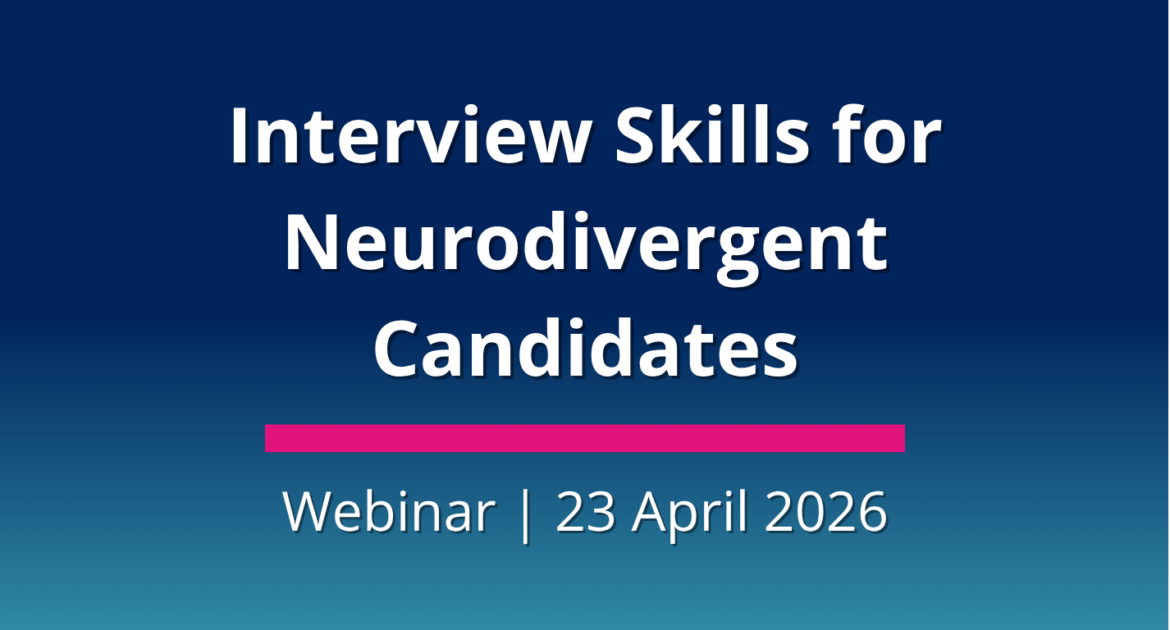
Interview Skills for Neurodivergent Candidates – Webinar Summary and Recording

Career Advice Thumbnail (3)

Webinar Summary and Recording

AuDHD coach and recruitment expert Lisa Gills shares insights from over 13 years in recruitment. 

She is ready to help you become confident and comfortable at interviewing by challenging common interview myths and exploring how masking can drain energy.  

What is Neurodivergence?

Neurodivergent describes people whose brain development or functioning differs from what is considered neurotypical. The term covers a broad spectrum of conditions, such as autism, ADHD, dyslexia, Tourette’s, and others. 

Lisa highlights how people are all different; it’s not about being better or worse, just about variation. That neurodiversity is real and more common than we often realise, and differences in how we think are a natural part of being human. 

15 to 20% of the UK population is neurodivergent. That’s approximately 10 million people. 

Watch clip >> 


The Biggest Interview Myth 

The myth is that interviews measure performance, not skill.  

Lisa emphasises this is not true, your performance at an interview is something that can be learnt and done so without masking. 

Interviews are meant to find the person who is the best fit for the role. 

When you are masking and trying to be who you think the interviewer wants, it uses up a huge amount of energy. Many people end up presenting a version of themselves that is not genuine just to get through the interview. 

That effort comes at a cost, and it stops you from bringing your best self into the room. 

Mastering the art of interviewing is not about learning to perform in a certain way or to be a completely different person, but about showing up as your best self. 

Watch clip >> 


Mask vs Real Exercise 

Lisa reviews some behaviours that you may exhibit in an interview, how the interviewer could perceive these, and what they actually mean.  

For example, if you are quiet and slow to respond, this is not you being hesitant, but you’re contemplating and considering your answer. 

When you can recognise these behaviours and understand the reasons behind them, it becomes easier to reframe them in a positive way and explain it to your interviewer. 

Lisa then goes on to further reflect on ways people mask and common struggles, and then why that is. 

For example, needing to stim is often due to the need to regulate your nervous system or your mind going blank at a question, which is due to processing under pressure.  

There are ways to communicate these difficulties or behaviours to the interviewer to address them professionally.  

If you go blank or need time to think of your answer, then say this, ‘I’d like to take a moment to think before I answer’.  

If you didn’t understand a question, ask for them to explain further, ‘I work best when I understand the full context’. 

This is how you can begin to reframe things, by adjusting your language and turning those actions into something positive. 

Watch clip >> 


Reasonable Adjustments 

Reasonable adjustments are not something a company gives you to be nice; they are a legal right. 

Under the Equality Act 2010, if the interview format puts you at a disadvantage because of how your brain works, the employer has a legal duty to adjust it.   

You do not need a formal diagnosis to ask for and receive reasonable adjustments.  

Some examples of reasonable adjustments you can ask for include: 

  • Interview questions in advance 
  • Extra time for the interview 
  • A quiet space to decompress beforehand 
  • To bring notes into the interview 
  • Written instructions as well as verbal ones 
  • Taking short breaks during longer interviews 

A company’s response to you asking for reasonable adjustments can also tell you a lot about the culture and how they value different ways of working and thinking. 

Watch clip >> 


How to Prepare for an Interview 

There is no right or wrong way to prepare for an interview; it is just about finding what works for you.  

The important thing is that you do prepare. Lisa quotes a saying attributed to Benjamin Franklin.  

‘If you fail to prepare, you are preparing to fail’. 

First suggestion is to write out your answers in full. Break down your answer into bullet points. Lisa says she used to use highlighters to mark out how she had answered each part of the job description with corresponding colours.  

Second, record yourself speaking. This gets you used to hearing your own voice and can help you prepare by recording voice notes of your answers. 

Thirdly, a verbal brain dump. If you don’t prefer writing your thoughts, perhaps if you have dyslexia, then speaking to someone out loud could help.  

Lastly, plan the interview day. Before the day, pick what outfit you will wear, figure out how you will get there, and what time you will arrive, etc. This will reduce decision fatigue on the day and leave you in a better headspace for the interview. 

Watch clip >> 


Managing the Day 

Arrive on time, giving yourself time to decompress but not too much time that you waste energy. 

Know your sensory plan, bring earphones, a grounding object or a fidget device.  

Remember that blanking is okay. Pause and acknowledge that you are taking time to consider your answer. The silence feels longer to you than it does to the interviewer. 

Pausing is not failure, you are allowed to pause, own it! 

Watch clip >>


Strengths Framing 

Lisa says to lead with your strengths and not apologies! 

At the beginning of the session, you reflected on the behaviours you might exhibit during an interview. Now you will look at how to reframe those into strengths. 

Some strengths could include – 

  • Attention to detail 
  • Analytical thinking 
  • Creative problem solving 
  • Heighten empathy 
  • Teamwork 

Watch clip >> 


Q&A 

  • How to keep track of answers while speaking? 
  • What adjustments can I request, and how can the panel accommodate? 
  • How/should I disclose my neurodivergence for an interview? 
  • How can I ask for support without a diagnosis? 
  • How can I spot a neurodivergent friendly workplace? 
  • How do I approach competency interviews? 
  • How can I read into the subtext of questions and expand on my answers? 

Watch clip >> 


Final Takeaways 

Lisa closes by asking you to do three things this week: complete the mask vs real exercise, contact an employer asking for reasonable adjustments (can be hypothetical), and write down three strengths you will bring to your next interview.  

Her final tips are – 

Ask for the adjustments that let you show up as yourself, because the version of you that’s masking isn’t the version that should be hired.   

It’s fine to be nervous.  

Always plan for your interviews. Never just go in and wing it.  

Remember your strengths are what make you worth hiring. 

Ultimately, enjoy it. 

Watch clip >> 


Meet the Host

Lisa Gills

Lisa Gills

Lisa Gills is an AuDHD entrepreneur, coach, and digital product builder whose work sits at the intersection of neurodiversity, career development, and accessible technology.

As founder of Harness the Spark Ltd, Lisa coaches neurodivergent professionals, particularly those in creative industries, helping them decode how their brains work, build on their strengths, and navigate careers in workplaces that weren’t designed with them in mind. Her coaching methodology is grounded in lived experience: Lisa is autistic and ADHD, and spent 13 years in advertising recruitment before her own journey of discovery led her to completely reimagine her career.

Alongside her coaching practice, Lisa is the creator of Dave, a free mental wellness companion app designed specifically for neurodivergent people. Built with low cognitive load, warm non-clinical UX, and neurodivergent-affirming language, Dave is available on iOS and Android and reflects Lisa’s belief that support tools should actually feel good to use.
What did you think of our article? - please rate

5 / 5. 7


Share this article

Reader Interactions

Written by Careers Advice

Career Advice articles are written by marketing specialists in professional services at the University of Warwick. Our writers specialise in Recruiting, Event Planning, SEO, Data Analysis, Social Media, and Marketing Strategy. Amongst the team, various degrees have been achieved, including Journalism, Public Administration, Multimedia and Web Design, Sociology, Media Production, and New Media Publishing. Over the last 25 years, the team has worked closely with academics, PhD students and professionals across multiple universities in the UK and globally, helping to share their stories and knowledge on a global platform, gathering many interviews, vlogs, webinars and workshops with the latest tips on working in Higher Education and Professional Services.

You may also like:

  • top job applications

    How To Become a Top Candidate With Your Job Applications | Webinar Summary and Recording

  • Career Advice Thumbnail (3)

    Build your personal brand for career success | Webinar summary and recording

  • Career Advice Thumbnail

    PhD Pathways: Bridging research and industry | Webinar summary and recording

Comments

  1. Artful Delice says

    21st April 2026 at 1:39 pm

    I would like to join the webinar for interview-skills-for-neurodivergent.
    I am on the Autism Spectrum and I am struggling to get any job interview or any job.
    I have IT skills and have qualification in NVQL3 in higher diploma in creative Media.
    I just need an opportunity show my skills and ability so then I can get a employment offer.
    I can even do voluntary work

    Reply

Leave a Reply Cancel reply

Your email address will not be published. Required fields are marked *

20 + 10 =

This site uses Akismet to reduce spam. Learn how your comment data is processed.

Primary Sidebar

Follow us

jobs.ac.uk shorts

Latest Jobs

  • Postdoctoral Researcher in Industrial Digital Twin and Intelligent Control Systems

    School of Intelligent Manufacturing Ecosystem, Xi'an Jiaotong - Liverpool University

    Location: Suzhou

    Salary: Competitive


  • Postdoctoral Researcher in Industrial AI Algorithm and Autonomous Decision-Making Systems

    School of Intelligent Manufacturing Ecosystem, Xi'an Jiaotong - Liverpool University

    Location: Suzhou

    Salary: Competitive


  • PhD Studentship: Real time 4D Imaging System for Turbulent Multiphase Flows

    Mechanical and Aerospace Engineering, The University of Manchester

    Location: Manchester

    Salary: £20,780 (for 2025/26)


  • PhD Studentship: Machine Learning Approaches to Whole-Particle Modelling of Pt Nanoparticles for Fuel Cells

    Centre for Doctoral Training in the Modelling of Heterogeneous Materials (HetSys), School of Engineering, University of Warwick

    Location: Coventry, University of Warwick

    Salary: Awards for UK applicants cover full University fees, give a research training budget and a tax-free stipend to cover living costs (standard UKRI rate £21,805 in 26/27 - equivalent to national living wage)


  • PhD Studentship: Extreme Space Weather: Modeling Rare Solar Storms and Their Impacts on Earth

    Centre for Doctoral Training in the Modelling of Heterogeneous Materials (HetSys), School of Engineering, University of Warwick

    Location: Coventry, University of Warwick

    Salary: Awards for UK applicants cover full University fees, give a research training budget and a tax-free stipend to cover living costs (standard UKRI rate £21,805 in 26/27 - equivalent to national living wage)


  • PhD Studentship: When Things Won't Let Go: Mathematical Modelling of a Sticky Problem in Industrial Drying

    Centre for Doctoral Training in the Modelling of Heterogeneous Materials (HetSys), School of Engineering, University of Warwick

    Location: Coventry, University of Warwick

    Salary: Awards for UK applicants cover full University fees, give a research training budget and a tax-free stipend to cover living costs (standard UKRI rate £21,805 in 26/27 - equivalent to national living wage)


Footer

jobs.ac.uk - Great jobs for bright people
  • Find a Job
  • Find PhDs
  • Career Advice
  • Jobs by Email
  • About Us
  • Contact Us
  • Terms of use
  • Privacy Policy
  • Cookie Policy
  • Accessibility Statement

Copyright © jobs.ac.uk 1998 - 2026

  • Find a Job
  • Find PhDs
  • Careers Advice
  • Jobs by Email
  • About Us
  • Contact Us
  • Terms of use
  • Privacy Policy
  • Cookie Policy
  • Accessibility
jobs.ac.uk - Great jobs for bright people

Copyright © jobs.ac.uk 1998 - 2026