

Early Career Researchers: How to write a compelling CV that creates your next academic interview
Getting your next role as an ECR starts with a winning CV that gets you to interview.
There is a common misconception that a CV is where you share your comprehensive career history with the hiring team. While it is true that your CV outlines your past work experience, it’s important to remember that the CV’s only true purpose is to get you to the interview stage.
This subtle but important distinction means that whether you’re applying for your first lectureship or next research role, here are the 3 steps to success:
- The Secret to writing a winning CV: the 15-second tip
- What a Winning CV looks like
- Tailoring a CV: The practicalities
The Secret to writing a winning CV: the 15-second tip
The biggest mistake ECRs make – and the quick fix
The single biggest mistake ECRs make is seeing the job search process from their perspective.
I get it: your contract is ending, and you need a job. When we feel panicked and scared, our world shrinks and we tend to only see things from our perspective. We write a CV sharing everything we’ve done and submit it.
And then wonder why we don’t get to interview.
The best tip to write a winning ECR CV?
It’s simple: Think of the perspective of your new PI or Head of Department.
They have to write grants, do the research, supervise their research team, teach, examine, review funding bids, network, do committee work – the list goes on.
In amongst this busy schedule, they now also have to read through numerous job applications. Most vacancies now have hundreds of applications, with more applications increasing due to the use of Gen-AI.
Your job is to think of your potential next line manager:
They are likely reading through applications either late at night, at the weekends, or while being distracted by the main duties of their day job. Recruitment is NOT one of their main tasks.
The reality is that it is easier for them to look for a reason to reject you, rather than to shortlist you.
The average time to review a CV was under 15 seconds, according to a 2024 eye tracking study.
The truth is that if your CV gets rejected, it doesn’t mean that the hiring manager doubts you can do the job. It’s likely because your suitability for the job isn’t jumping off the page.
Remember: The hiring team has a puzzle to solve and it’s your job to make it easy for them to see that your CV presents a solution.
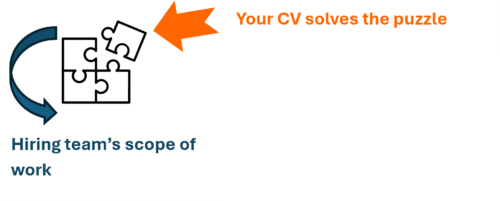
This means that in 15 seconds, your CV needs to convince the reader to not reject you, and that means you need to make it easy for the reader to see how your CV solves their job vacancy problem.
So – how do you actually do this?
3 questions to ask yourself BEFORE you write your CV
- Why YOU?
There will be several other candidates who all meet the essential and likely desirable criteria. What makes you different?
Maybe you like mentoring PhD and Masters students, perhaps you are a whizz at coding, or you could be particularly collegial. Whatever it is (and there will be something!), make sure you identify what that is.
In an AI-filled world, being able to articulate your human characteristic will catch the reader’s eye.
If you need help with identifying your specialist strengths, the 2025 Vitae Research Development Framework will give you lots of ideas, including language to clearly help you articulate your skills. For example, 3.2 Project management suggests language such as “balancing multiple streams of activity”.
- Why THEM?
I know you need your next role, but the recruiting organisation (like all people being wooed) need to know what’s special about them. This information does usually belong in the cover letter, but a quick mention in your personal profile at the top of your CV (see below) can make your CV stand out.
- Why NOW?
I know the real answer is that you need a job, but that’s not what you say!
PIs/Heads of Department want to give the role to an ECR who can make a clear story about why this exact role builds on previous knowledge and how it will be the right stepping stone on their academic career journey.
Again, there is more opportunity to expand on this in your cover letter, but adding this to the personal profile of your CV can help provide a clear narrative.
The more you invest in this stage of the job application process, the easier it will be to write a winning CV and tailor it to the specific role.
What a winning Early Career Researcher CV looks like
Academia loves acronyms, so I couldn’t resist creating one for a winning CV:
White space and headings
Research prominent on the first page
Integrate research skills into each position
Take each essential criterion and address it as an appendix to the CV
Elevator pitch in your personal profile at the top of the CV
White space
Changing the margins? Reducing the font?
These are common practices when trying to cram as much information as possible into the CV.
White space is a presence, not an absence.
Try this tip to see your CV afresh: zoom out to change the display to be 70%. Instead of reading the individual words, actively look for the white space.
Is each section clear and distinct? Your headings should be directing the reader. If a reader wants to find your conference attendances, can they find it quickly?
Always make sure you write full pages – whether that’s 2 pages or 3 (or more). Never make a CV 2 and a half pages for example.
Research prominent on the first page
As an ECR, you will undoubtedly be keen to show you have been developing a bank of expertise in your research area, as well as developing essential research skills.
When zoomed out, your CV’s first page should be dominated by your research experience and research skills, for a research-intensive role.
Key ways to do this are to make sure the first section on your CV after your personal profile is ‘Relevant Research Experience’ or similar words.
Maximise your research experience by listing your doctoral research here. You can use the word ‘Doctoral researcher’ as a job title, as this reminds the reader of your research credentials.
Tailor your research achievements using the specific wording used in the job description (see more in the next section).
If you are applying for a role as a new lecturer, which is more teaching-focused, then make sure to also include your teaching experience on the first page.
If you need some ideas about other sections to include, check out our other guide, the Academic CV Guide for PGR Graduates, which has an extensive list of potential sections to include in an academic CV.
One common mistake is to waste space on the first page with your degree qualifications. I would recommend simply making your name as either Dr. First Name Surname or First Name Surname, PhD. This quickly establishes you as a researcher. Your first degree and any postgraduate qualifications can go towards the end of the final page.
Integrate research skills into each of your roles
Some people include a separate research skills section on their CV. Unfortunately, this often just looks like a list of skills, with no evidence of what you actually achieved. In short, research skills without context are unconvincing.
Instead, within each role you’ve had, include details of what research skills you’ve utilised and what you achieved. Provide the context of how you developed these research skills.
For example, for a qualitative researcher, a list of research skills could simply look like:
Participant recruitment, Interviewing skills, NVivo software, thematic analysis
Instead, a more convincing way to evidence these skills is by contextualising them within the role where you developed these skills:
Doctoral researcher, University of X, UK Dates
- Proactively engaged in participant recruitment by exploring relevant networks such as NIHR, MRC patient groups
- Created rapport quickly with my interviewing skills, enabling rich data from 34 participants
- Analysed data using NVivo software to create adult and child nodes, using the memo and annotation features
- Conducted thematic analysis using NVivo by data familiarisation, creating and refining themes
In short: show, don’t tell.
Take each essential criterion and address it as an appendix to the CV
In order to shortlist fairly, the reader is looking to see you meet each essential criterion and so making it as easy for them as possible will enhance your chances of being shortlisted.
Assuming there is no page limit for the CV given in the job vacancy, I would recommend adding an appendix to the same document of your CV where you take each essential criterion and show how you meet it.
If there is a page limit, you can instead add it to your covering letter or supporting statement where there is usually more flexibility on page limits.
For instance:
- Excellent communication skills (oral and written), including strong presentation skills
Strong presentation skills are evident in my conference presentations as invited speaker (X conference 2024) and as a panel member at Y conference 2025. Excellent communication skills evidenced by 5* student feedback from lectures and seminars and nominated for a teaching award. Excellent written skills are evidenced by my recent writing for leading publications, as well as authoring a chapter in a book.
Elevator pitch in your personal profile at the top of the CV
While there are different perspectives on whether it is a good idea or not to add a few lines at the top of your CV as a personal profile, my recommendation is to use it. Simply put, it’s your “elevator pitch” to the reader to convince them to read more. Readers are busy, so a personal profile acknowledges this and makes it easy for the reader to decide whether to reject or read on.
This is where the simple 3-part structure of ‘Why you, Why them, Why now’ can help the reader. For example:
Social Sciences Researcher with 5 years’ experience in leading poverty research in a research-intensive university. After my doctoral research in looking at the confluence of poverty and pollution, I have been researching poverty pathways, leading to 3 publications, including 2 sole-authored articles. I am now ready to step into my first lectureship role at the University of Y as your research priority areas include addressing child poverty. I am highly motivated to bring my research expertise, positive approach, and mentoring skills to contribute to achieving your aim to be a global top 50 university by 2030.
Tailoring an Early Career Researcher CV: The practicalities
All careers advice generally includes a strong recommendation for tailoring your CV.
What does this actually mean?
Simply put, use the wording from the job description to contextualise what you have achieved in your work roles.
Your original CV:
Used the supercomputing cluster McLeod at the University of X to code for malarial disease transmission genetics and conduct statistical data analyses
Job description criterion:
Experience in high-performance computing, in particular writing efficient computational code for genetic and statistical data analyses and simulation studies
Tailoring your CV:
Doctoral researcher, University of X, UK Dates
- Performed high-performance computing (HPC), using 10TB of datasets to code for malarial disease transmission genetics and conduct ANOVA statistical data analyses
FAQs:
I worked before I started my research career. Where do I put that on the CV?
If you have work experience that is not strictly research-based but has relevant research skills, include this too. When short-listing, having something on your CV that makes you standout can help. For instance, I have worked with an ECR who was previously a Divemaster. This is pretty unusual but also has the benefit of useful transferable skills. Using the the 2025 Vitae Research Development Framework, you can see that this researcher can exemplify skills of leadership (5.3) e.g. guiding less experienced divers, offering direction and support, and skills of supervision (5.4) e.g. setting clear expectations, communicating goals, and negotiating realistic timelines.
My research roles have been very short-term: just a few months long. Do I add the month and year?
This may simply depend on the formatting of the CV. Remembering the importance of white space and having full pages, it could be that you simply focus on the year. Alternatively, you could group different roles together, especially if you were at the same institution.
How do I make my one postdoc role sound more impressive?
The key here is to focus on what you achieved, rather than what the responsibilities of the role are. It also pays to use ‘action words’ (see Academic CV Guide for a PhD Graduate for more examples).
Which sounds better?
- Responsible for maintaining lab equipment
OR
- Led on ensuring lab equipment was cleaned and serviced regularly, reducing down time thereby improving efficiency rate.
Try to also quantify as much as you can e.g. 35 participants, 10TB of data.
I’m not sure if I am an ECR or a mid-career academic. Where can I go for CV advice for a mid-career academic?
There is no single definition of an early career researcher, but a typical profile would be someone who has completed their PhD qualification (or has equivalent research experience) and has a few years of additional research experience, including postdoctoral work. They are likely to aspire to becoming a tenured professor and are building up their research expertise.
What’s the definition of a ‘few years’?
Well, it can be very generous! The British Academy Early Career Network, for instance, “welcomes those who have completed PhDs, typically within ten years of award, but allows flexibility for those who have had career breaks”.
In short: If the term ‘Early career researcher’ resonates with you, this article is for you.
If you feel that you are unsure whether you count as an ECR of a mid-career academic, also check out our article on Academic CV for a Mid-Career Academic.
I’ve taken your advice and I’m still not sure if I have written a winning CV. Where can I get help?
It’s always a good idea to get an outside perspective. Share the job description with friends or family, and show them your CV. Even without specialist academic expertise, they should be able to identify that you have tailored the CV to the job description. They will also share whether they found it too dense to read, and whether there was enough white space to help them read the CV. Be open to their ideas, as they are reading your CV as a non-specialist reader, which is likely if HR screens the CVs before they get to the PI/Head of Department.
Your university may provide career support to researchers, and if so, use the opportunity to get more feedback.
You can also get feedback from your supervisor/current PI.
Another great idea is to create a peer network where you support one another – simply take turns to read each other’s CVs and supporting statements, and then exchange feedback. Creating this support network can be really useful, as having people willing to do this will be very helpful throughout your career. The more CVs you read, the faster your road to writing your own winning CV.
Good luck!


Leave a Reply