
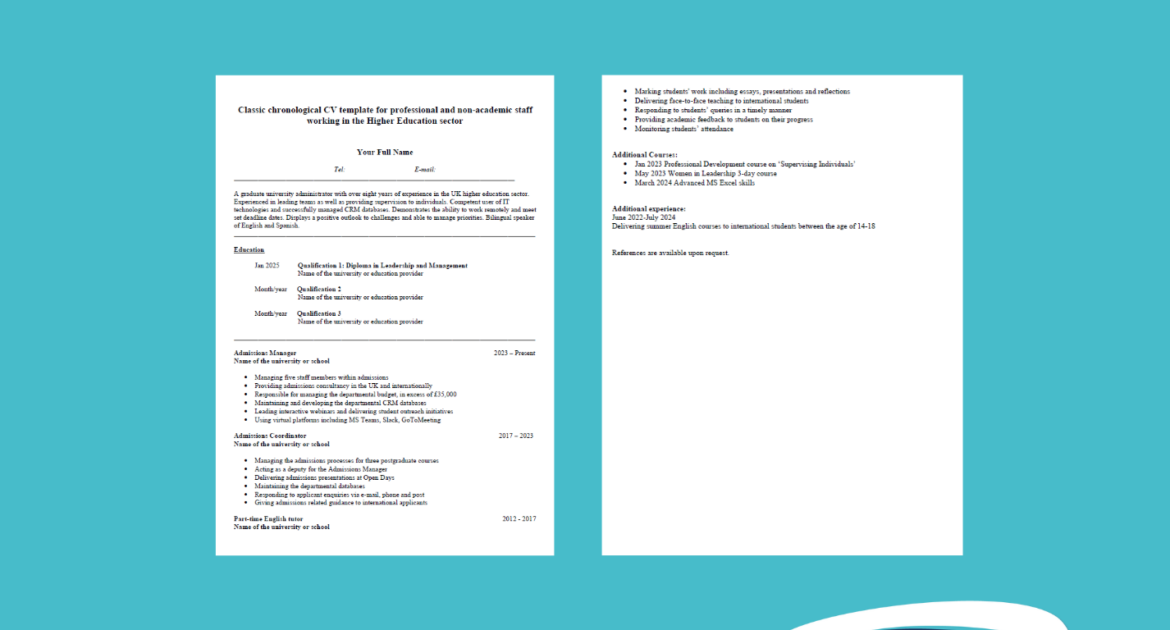
A classic chronological CV is the most often used CV format in the UK. It shows your recent educational and work experience first (from most recent to oldest) in chronological order. This format is particularly helpful if you have consistent professional experience.
Using the template below could help you save a significant amount of time and effort. While there is no one-size-fits-all approach, this template provides a clear structure you can easily tailor to your experience, which can be used by professional and non-academic staff working in the Higher Education sector. You can make this template bespoke to your experience and background.
What is a Classic Chronological CV?
A classic chronological CV helps you to highlight your career progression and the tasks you have undertaken in each position. It is especially useful if you have relevant work experience for the role you are applying for, and you can show good career progression over the years. You will be able to highlight the results you have achieved, the responsibilities you have taken on and some challenges you have resolved. However, this format may not be ideal if you have changed your career recently, you have gaps in your CV, or you have frequently changed employers. In this case, you may find it helpful to consider other CV formats e.g. skills based. If you would like more information on how to create a skills-based CV, please look at the following jobs.ac.uk article at https://career-advice.jobs.ac.uk/cv-and-cover-letter-advice/skills-cv-template/
Chronological CV Format:
- Header (name and contact details)
- Personal statement (about 5 lines summarising your background)
- Education section and Work experience (do include your education history first if you wish to highlight your previous studies. If you would like to emphasise your work experience, you may include this before the education section).
- Optional: further qualification, volunteering, relevant interests
A Classic CV is a marketing tool which outlines your qualifications, employment history and skills. Even though you may be applying for a number of roles, it is essential that you create a bespoke CV for each role. Recruiters can easily spot job applications which are generalised and do not align directly with the job description.
A well-written CV tells a story about your professional life and your career progression. This story needs to convince the hiring organisation (i.e. higher education organisation/ university) that you are a candidate with lots of relevant credentials.
The purpose of your application is to give your future employer (the hiring university) a taste of your skills and experience. Cramming too much into a CV is a common mistake. This approach often leads to creating generalised, vague and confusing applications. The clearer, more structured, and more bespoke your CV is, the more likely you are to receive an interview invitation and take the next steps in your application journey.
How to use a Classic Chronological CV template?
Please be aware that the suggested classic CV is only an example. Do use it as a template; however, make sure that your application is tailored to the job you are applying for. It is best however, not to copy and paste phrases. Instead, do use your own writing style whilst taking ideas from the below.
If you are applying for roles within the Higher Education sector, it is essential that you highlight your experience of working for other universities as well as how you have developed your skills over the years. You would want to show strong alignment between your previous university roles and responsibilities and the position you are applying for.
How to Tailor Your CV
Before using the free classic CV template below, please review the job description for the position you are applying for. Make sure that you clearly understand the criteria and the expectations. Ask yourself the below questions:
- What are the key skills the recruiter is looking for?
- What could make your application stand out?
- Do you have any transferable skills which you could use?
- To what extent does your educational and professional experience align with the expectations?
Tips for Writing a Strong Classic Chronological CV
- Never submit a generalised CV. Always make it bespoke to the vacancy you are applying for
- Research the university before drafting your application
- Do avoid grammatical and punctuation errors
- Never copy and paste information from the job description onto your CV
- Avoid vague, generalised and broad expressions
- Put yourself in the recruiting university’s position and ask yourself ‘How does the application align with the expectations?’
- Only submit the CV when it is completely polished
A well-structured, classic chronological CV can be useful to demonstrate your professional experience. Use this template as a foundation, tailor it to each role, and focus on demonstrating clear career progression and measurable achievements.
For more CV tips and advice, please see:
- The Key To The Perfect CV
- Is Your CV Too Long? 6 Effective Fixes
- The Questions Your CV Really Needs to Answer
- 4 Reasons Your CV Could Be Ignored


Great