

What is a narrative CV?
A narrative CV is a relatively new CV format, and is very different to the traditional academic CV. It is only used in certain situations, so you would only write in this style if you were specifically asked to provide a narrative CV for an application.
The Declaration on Research Assessment (DORA) define a narrative CV as providing a structured written description of a person’s contributions and achievements that reflects a broad range of relevant skills and experiences. In other words, a narrative CV goes beyond simply outlining what you have done, it also highlights how you have achieved it. It provides a richer picture of your journey, demonstrating how your contributions, skills and experiences have shaped you into the researcher you are today.
The narrative CV format can also be used for a whole research team, not just an individual. Rather than submitting multiple separate CVs, applicants contribute to a single document that captures their combined expertise, experience and achievements. This enables the review panel to assess the collaborative strengths and collective capability of the whole research team and gain a clearer understanding of their overall potential.
When and why is a narrative CV used?
A narrative CV is often requested by research funding bodies. For example, when applying for an individual fellowship, or for a team project. Within the UK they are particularly favoured by the UKRI and Royal Society, although their popularity is spreading, and many funders, including outside the UK, are now utilising them.
The National Institute for Health Research (NIHR) investigated the use of the narrative CV and concluded that the format may facilitate positive changes in the broader research ecosystem, including:
- Recognition of broad and valuable contributions to the wider research environment from applicants beyond traditional academic outputs.
- Recognition of diverse career pathways into academia and associated transferable skills.
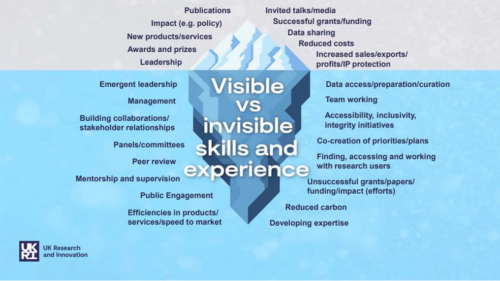
- Recognition of ‘invisible’ research activity and wider acceptance of all research findings as valuable.*
The UKRI state that the format reduces the focus on continuous linear productivity and emphasises quality over quantity.
*UKRI have identified ‘invisible’ skills and experiences that are just as relevant to the research process as the more ‘visible’ ones, and all would be welcome to be included in a narrative CV.
Narrative CV Structure
If you are asked to submit a narrative CV, the funder may require you to use a specific template. In the UK, one of the most widely used formats is the Résumé for Research and Innovation (R4RI), which evolved from the Royal Society’s Résumé for Researchers. For funding applications outside the UK, alternative narrative CV templates may be specified, so it is important to check the funder’s guidance carefully.
The R4RI consists of four sections, or modules, each focusing on a different level of impact. It starts by focusing on you as a researcher and your individual contributions and achievements, before broadening to consider your impact on your team, then the wider research community, and finally the difference your work has made to society and the public.
Résumé for Research and Innovation template:
Explain your contributions to the generation of new ideas, tools, methodologies or knowledge.
When writing this section you could include:
- How you communicated your ideas and results.
- Generation of new ideas and hypotheses.
- Key outputs, such as research publications, data sets, software, protocols, products, patents, artefacts, exhibitions and policy publications.
- Development of methods, tools or resources.
- Skills acquired from past research projects.
- Funding you have won and/or awards you have received including invited talks.
Explain your contributions to the development of others and maintenance of effective working relationships.
When putting this section together, consider including:
- Management, supervision or mentoring you provided that was critical to the team’s success, including project management.
- Teaching activities, workshops and mentoring.
- Your leadership in shaping the direction of a team.
- Establishing or driving collaborations or networks, focusing on the working relationships rather than the research.
Explain your contributions to the wider research and innovation community.
Consider adding the following information to this section:
- Positions of responsibility.
- Commitments such as reviewing, editing and committee work.
- Aiding improvement of research integrity or culture.
- Your strategic leadership in influencing a research agenda.
- Contributions to professional bodies.
- Organisation of community events, such as conferences or workshops.
- Contributions to open research, active sharing of knowledge and skills, community resources.
Explain your contributions to broader research or innovation users and audiences and towards wider societal benefit.
For this section, consider covering:
- Knowledge exchange, bringing together researchers, users of research and wider groups and communities to exchange ideas, evidence and expertise.
- Public engagement with research (PER) and public understanding.
- Partnerships with business, industry, healthcare, and so forth.
- Patient and public involvement (PPI).
- Participatory research.
- Research which has contributed to public understanding.
- Research which has contributed to policy development.
- Commercialisation of research.
- Responsible research and innovation (RRI).
There is also an Additional information section where you can provide any contextual details such as career breaks, secondments, voluntary work etc. Be aware, the UKRI state that this section will be seen by the panel and reviewers even if it references a sensitive issue. If you need to write about a sensitive issue, they recommend you focus on how the issue has affected your career, rather than expanding on the issue itself. Do not use this section to describe additional skills, experiences or outputs, as this information will not be assessed.
Tips on content
As the name suggests, a narrative CV is written primarily in prose, although bullet points can be used where appropriate. However, this does not mean it should be lengthy or overly detailed. The narrative CV format is intended to shift the focus from quantity to quality, therefore you should emphasise the significance of your contributions, rather than list all your achievements.
Funders may set word limits for each section, so it is important to check the guidance carefully and adhere to any requirements. Be selective in the examples you include, focusing on those that are most relevant to the funding opportunity and best demonstrate your skills, experience and impact.
One of the most important aspects of a narrative CV is providing evidence of your achievements, this can be both quantitative and qualitative. Focus on the outcomes of your work and how you enabled them, rather than simply stating activities you undertook. Avoid long lists or excessive detail; instead, provide clear, concise evidence that will help the assessors understand your strengths and contributions.
Demonstrating impact and contribution
Highlight the impact of your work on your team, organisation or research field, and clearly identify your specific role in achieving it. The benefits may be social, economic, environmental, health-related or cultural in nature. Above all, demonstrate how you made the most of the opportunities available to you and the difference your contributions have made. Providing context can also be valuable, helping assessors understand how particular experiences developed your skills or represented significant achievements at your career stage.
Using publications effectively
When referring to publications, go beyond simply listing them. Provide context by briefly explaining the research, its significance and the contribution it has made to the field and, where relevant, to wider society. Remember, one of the aims of the narrative format is to move away from an overreliance on metrics (such as journal impact factors or the h-index), so choose your examples carefully and focus on the influence and impact of the work.
To reference publications, use a digital object identifier (DOI) hyperlinked to the publication. To save space, avoid including the full title or citation unless specifically requested by the funder. For collaborative outputs and projects, use the CRediT Contributor Roles Taxonomy to articulate your individual contributions, helping assessors understand your role and responsibility within the work.
You may find it challenging to identify examples for every section of a narrative CV, particularly if you are at an early stage in your career. In these cases, it is important to provide context by stating your career stage and the length of time you have been active in your research field. This helps assessors evaluate your achievements relative to your experience and opportunities. You can also use examples from outside of academia, such as a leadership role in another sector or a voluntary role. It is also perfectly acceptable for some sections to be considerably shorter than others.
Further guidance
Currently, funding bodies are reluctant to provide example narrative CVs, as they do not want to discourage researchers from taking an individual approach or limit their thinking about what evidence and experiences they might include. The intention is to encourage applicants and teams to present a broad and authentic account of their contributions, achievements and impact, rather than conforming to a single model or style of narrative.
The University of Oxford have written some helpful guidance on writing both an individual and team narrative CV.




Leave a Reply