
How to Write a CV That Gets You Hired (2026 Guide)
How do you write a graduate CV that actually gets interviews in a competitive 2026 job market?
jobs.ac.uk understands how competitive the 2026 job market can be. Become a top candidate by downloading our latest CV guide created by Farrah Morgan, The Grad Coach, who has worked with 200+ young professionals 1:1 and 4000+ more within online webinars.
Free graduate CV template and 50-word action verb list available below.
After 10 years of hiring and coaching graduates, I can tell you this with confidence: most CVs don’t get rejected because you can’t do the job. It’s because you’re making the hiring manager work too hard to see that you can.
Employers aren’t asking, ‘is this the smartest candidate?’ They’re asking, ‘is this the best match for what we need?’ Therefore, it is not the best candidate who gets hired. It is always the best communicator!
In this guide, I’ll walk you through a proven 2-step system to build a graduate CV that not only meets expectations but positions you as a top 1% candidate.
Download Template here
Why Most Graduate CVs Get Rejected: The 7 Biggest Mistakes
Before you improve your CV, you need to understand what’s holding most candidates back.
Having reviewed thousands of applications, I’ve found that most rejected CVs fall into the same 7 biggest mistake areas:
1. Is your CV too long?
A CV that runs beyond two pages loses impact fast. Hiring managers are unlikely to read your entire CV. They will scan for the most enticing parts to them and in seconds!
Top Tip: Keep it concise and targeted at 1-2 pages. Relevance always beats volume.
2. Are there sloppy errors?
Spelling, punctuation, grammar and formatting mistakes instantly damage your credibility.
In a world of AI tools and spell checkers, these errors are completely avoidable. And hiring managers will judge you for them.
Top Tip: Check every application through Spellcheck, Grammarly or AI using British English. Error-free work = you taken seriously.
3. Are you using an amateur format?
Creatively designed CVs and skill-based CVs are a red flag to employers. They signal inexperience and prioritise design over substance.
There’s a reason boring CVs work! You command authority and attention with the language you use and the results you include – not the design.
Check out our free graduate CV available for download. No amateur formatting in sight!
4. Are you missing quantifiable results?
Most candidates list responsibilities. Top 1% candidates consistently sell results.
Numbers, percentages and monetary amounts transform your experiences into credible and memorable indicators of your future value. Exclude them and you risk sounding like every other candidate with the same basic responsibilities.
Top Tip: 1 quantifiable result for every CV bullet. For guidance on how, check out my video tutorial.
5. Is your language too weak?
Words like “assisted”, “helped”, and “supported” dilute your contribution. There is almost always a stronger, more assertive way to describe your work.
If you can’t articulate your work with authority, no one else will.
Top Tip: Start every CV bullet with a powerful action verb. Find a 50-word list in our free graduate CV download.
6. Are you not tailoring your CV?
Even with all the above mistakes removed, your CV is still not yet tailored and won’t cut through in today’s competitive graduate market. You must tailor every application for that specific opportunity, optimising for both human hiring managers and applicant tracking systems (ATS).
Top Tip: Build 1 powerful master CV that communicates 90% of the value. Then iterate tailored versions that add the final 10%. More on exactly how to do this in Step 2 below.
7. Is your application volume off?
Getting hired in today’s market is going to take more than just 1 stand-out application. So how many will it realistically take?
Too few applications means not enough visibility. Too many means quality suffers.
Top 1% candidates balance both, crafting outstanding applications at scale.
How to Write a Graduate CV: The 2-Step System
A top 1% graduate CV is not built in one go. It is built in two distinct stages.
- Step 1: Build your Powerful Master CV – your foundation, aligned to your target sector
- Step 2: Tailor Stand-Out Applications – adapting that CV for each specific role
Most candidates either skip Step 1 and rush into applications or stop at Step 1 and never tailor properly. Both approaches will severely limit your results!
Step 1: Build Your Powerful Master CV
Your Master CV is not a generic document. It is sector-aligned, results-driven, and built to showcase your strongest experience – ready to be tailored for each application.
What to Include in a Graduate CV
A well-structured graduate CV typically includes the following sections:
- Header: Name, contact details, LinkedIn and the official job title and organisation you’re applying for (this is a quick ATS win)
- Personal Statement: A short, tailored paragraph written for each application (more on this in Step 2)
- Education: Unpacked with key modules, projects and achievements – not just a degree title and grade
- Industry-Relevant Experience or Projects: Your most relevant roles, internships, societies or projects placed first (these do not need to be paid, full-time work)
- Other Work Experience: Less relevant experience that still rounds you out as a candidate (think part-time retail, hospitality, but still written powerfully)
- Other Achievements and Interests: Courses, languages, extracurriculars – kept brief and relevant
How to Write a Graduate CV with No Experience
One of the biggest concerns I hear is: “What if I don’t have any experience?”
In reality, most graduates do have experience. It’s just not positioned effectively.
- A part-time retail role demonstrates communication, commercial awareness and problem-solving
- A university society role can demonstrate leadership, project management and stakeholder engagement
- An academic project shows research, analysis and the ability to deliver under pressure
Your task is to translate that experience into relevance.
How to Move from Responsibilities to Results
This is the single biggest upgrade most graduates can make to their CV.
Most CVs read like job descriptions:
- ❌ “Responsible for managing social media accounts”
- ❌ “Assisted with invoices”
Strong CVs sell quantifiable results:
- ✅ “Grew society’s Instagram engagement by 35% in 8 weeks by developing Q1 short-form content strategy with viral reel research and competitor analysis.”
- ✅ “Executed weekly invoices for 200+ clients within 72-hour deadlines by collaborating with 5 senior accountants and demonstrating strong attention to detail.”
Employers don’t just want to know what you did. They want to know how well you did it. It is your responsibility to make that clear.
How to Structure High-Impact Bullet Points
Strong bullet points follow a simple three-part formula:
- Powerful action verb (e.g. Delivered, Generated, Led, Increased)
- Quantifiable result (a number, %, or £ amount)
- Strategy (how you achieved it)
Example:
“Managed (action verb) an annual society budget of £20,000 (result) by allocating funds across multiple projects and leading a sub-committee of 3 to execute monthly reconciliations (strategy).”
🎥 Want to see this in action? Watch the accompanying video where I walk through real before-and-after CV transformations, showing exactly what takes a graduate CV from average to top 1%.
Skills Employers Look For
As a former hiring manager, I can tell you that the core skills most graduate employers look for haven’t changed much over the past decade. The context has shifted, remote working, AI, and a faster pace of change, but these qualities remain almost universal across graduate roles:
- How you work with people: e.g. communication, collaboration, stakeholder management
- How you approach work: e.g. problem-solving, adaptability, resilience, attention to detail
- Your overall attitude: proactivity, trainability, motivation to learn, demonstrable passion for the role and company
However, here’s where most candidates go wrong. They throw them into a random “skills section” without anchoring them to anything real. Anyone can write “strong communicator” or “team player”. Top 1% candidates prove it by weaving the skills an employer is asking for directly into their experience and education bullet points. Skills + results + context = believable!
Top Tip: The Standout CV template includes a “Key Skills” bullet at the end of each experience section. This is a smart way to signpost in-demand skills clearly, while keeping them anchored to a specific role or achievement.
Step 2: Tailor Stand-Out Applications
Once your Master CV is strong, tailoring is what actually gets you interviews.
This is where most candidates fall down – and where you gain your competitive advantage.
ATS Tips for Graduate CVs: Writing for Two Audiences
Imagine every CV you submit needs to impress two completely different audiences:
- Human hiring managers (subjective)
They spend 6–20 seconds scanning your CV. They respond to clear language, strong results and a CV that “feels” tailored to them specifically.
- ATS (objective)
ATS (Applicant Tracking Systems) are used by 90% of large organisations, and this number is growing across SMEs and the public sector. ATS are used by the vast majority of large organisations globally (Jobscan’s 2025 research found 97.8% of Fortune 500 companies use one), and adoption is growing across SMEs and the UK public sector, including higher education. These systems filter for specific keywords and phrases from the job description. No synonyms or paraphrasing – exact words!
If your CV doesn’t satisfy both audiences, you risk being one of the many candidates immediately rejected.
How to Tailor Your CV Effectively
- Wherever you can, match the employer’s vocabulary versus paraphrasing. If the job description says “project management”, use “project management” rather than a synonym like “team coordination”. This helps a hiring manager instantly connect the dots between your skills and their needs, without needing to read between the lines. Remember: top 1% candidates make the hiring manager’s job as easy as possible to understand your relevant value.
- Prioritise relevant experience: reorder your bullet points and sections to lead with what matters most for each specific role
- Tailor your personal statement: this should act as a mini cover letter, referencing the specific role, company and the qualities they are looking for
Common Graduate CV Mistakes to Avoid
Don’t forget the 7 major mistakes we covered earlier in this guide. They are the most common CV culprits:
- Too long
- Sloppy errors
- Amateur formats
- No quantifiable results
- Weak language
- No tailoring
- Wrong volume
Work through each one honestly before you submit, and you’ll already be ahead of the majority of candidates.
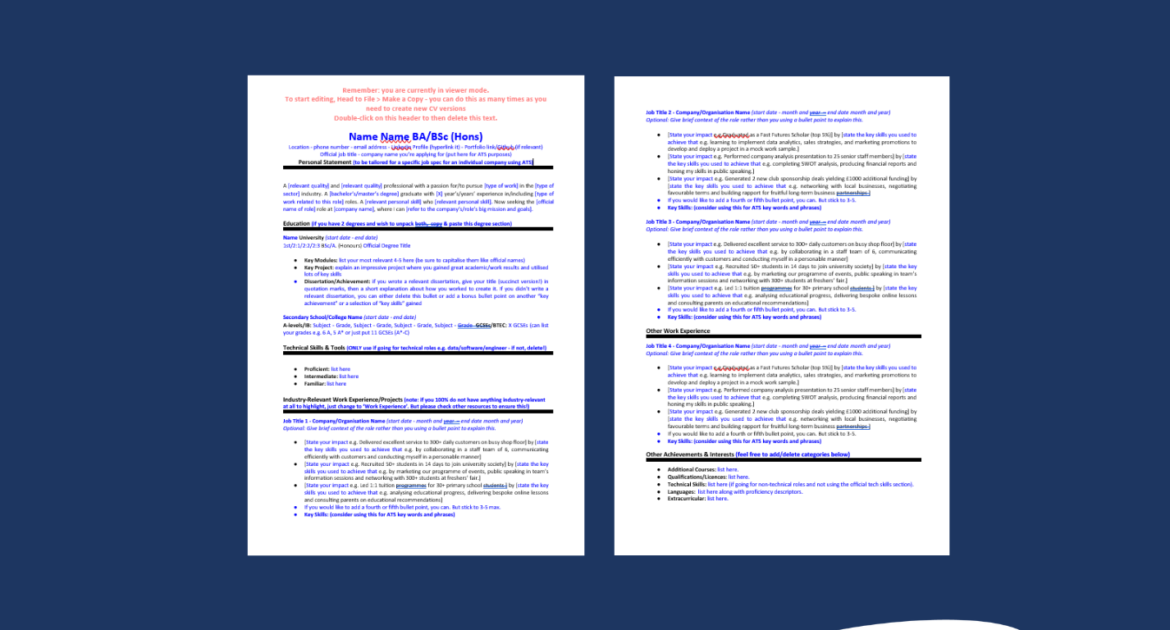
Free Graduate CV Template UK from jobs.ac.uk (Approved by The Grad Coach)
To help you apply these principles immediately, download the free graduate CV template below.
This template is designed to:
- Highlight your most relevant experience in a clear, scannable structure
- Showcase results clearly and confidently
- Work effectively with both ATS systems and human hiring managers
📄 Download the free graduate CV template in different formats
What Makes a Top 1% Graduate CV?
A good CV gets you in the pile. A strong CV gets you rushed to interview!
The difference comes down to three things:
- Communicating your value clearly
- Answering why your experience matters to this specific employer
- Presenting yourself in a crisp, organised way so hiring managers can easily say yes
As you reach the end of this guide, here’s a friendly reminder. It’s okay to pause on applications and work on your foundations first. That’s not moving backwards, it’s preparing to move significantly further forward.
More applications is not always the answer. Stronger employability skills usually are. And the most important one? Learning to communicate your value clearly. Because remember: it’s not the best candidate who gets hired. It’s the best communicator.




These are great tips that really matters. These are really helpful. Many thanks
Is good and excellent.